A softer way home. Curves that work in real Indian flats.
A rounded corner can change the feeling of a room. So can a generous curved sofa or a quiet arch behind a bed. The trick is not to make everything wavy. It is to let softer shapes work alongside the ordinary straight lines of an apartment, without losing storage, circulation or a comfortable place to sit.
Start with the shape that earns its place
Look at the room from its entrance. Where does the eye stop, and where does the body move? An exposed cabinet corner beside a passage might benefit from a softer edge. A living room with plenty of rectangular surfaces might welcome an oval coffee table. Begin with an actual opportunity rather than adding an arch because a reference image has one.
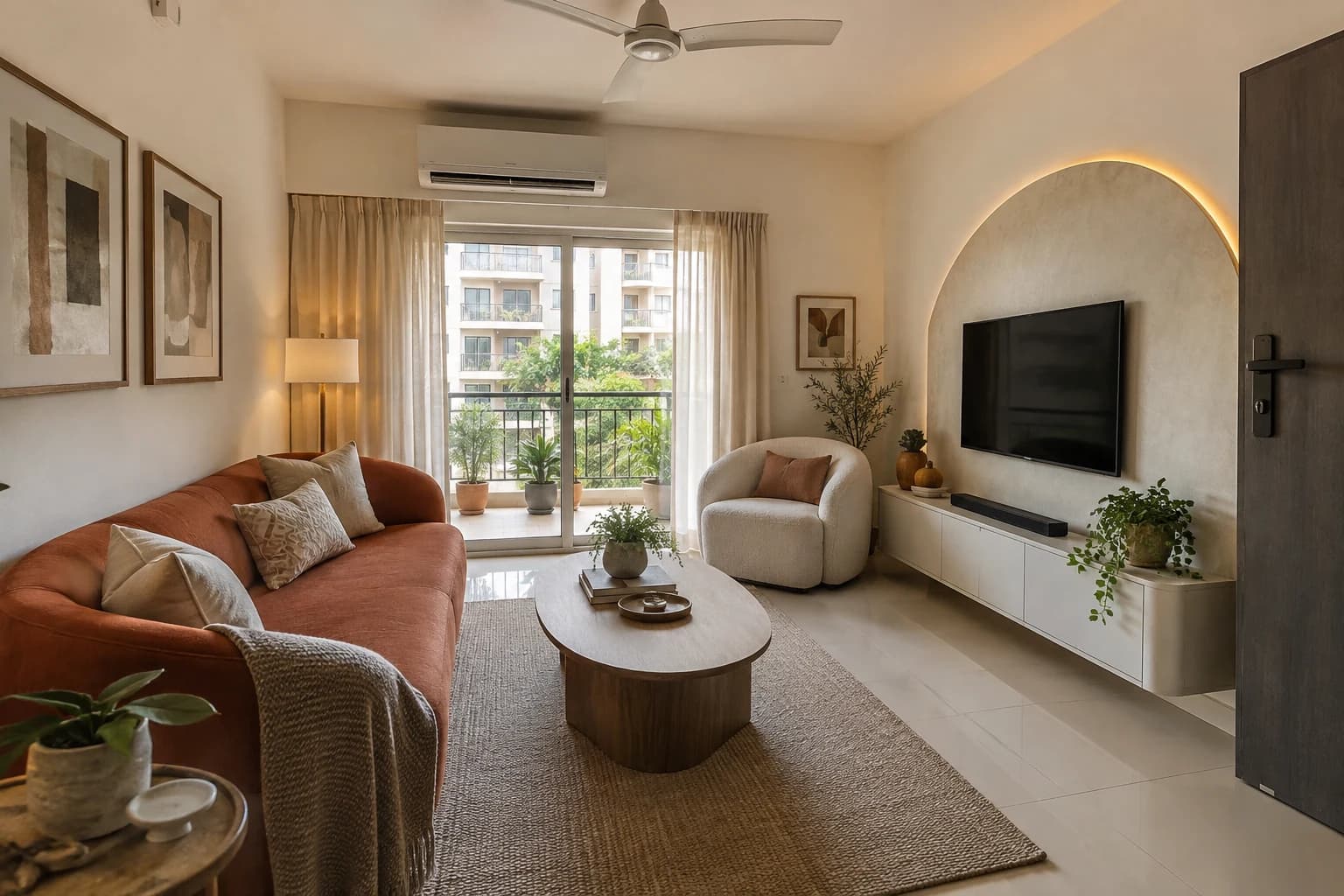
Choose a leading curve and one or two quieter echoes. A curved sofa could relate to the rug and a rounded cabinet end. The window, doors and most storage can stay straight. That contrast gives the softer pieces room to be noticed.
There are several kinds of curve: a radius on an exposed edge, a rounded furniture silhouette, a scalloped decorative panel, an arched opening or a flowing wall. They have very different implications for space and construction. Be clear about which one you mean when discussing a budget.
A curved living room without a giant sofa
Curved sofas can be deeper than they first appear. Measure the full footprint, including the space behind the back, and test how they face the television and other seats. A beautiful crescent that leaves everyone twisting to talk is not an improvement.
In a compact flat, a straight sofa with softened arms may be the better base. Add a rounded lounge chair, an oval table or a pair of small nesting tables. Keep the route to the balcony open and check the gaps with someone seated, not only with all furniture empty.
For a more fully curvy room, use related proportions: one broad sofa arc, a quiet rounded cabinet and a generous oval rug. Avoid making each object a competing sculpture. A restrained palette and ordinary apartment details keep the room believable.
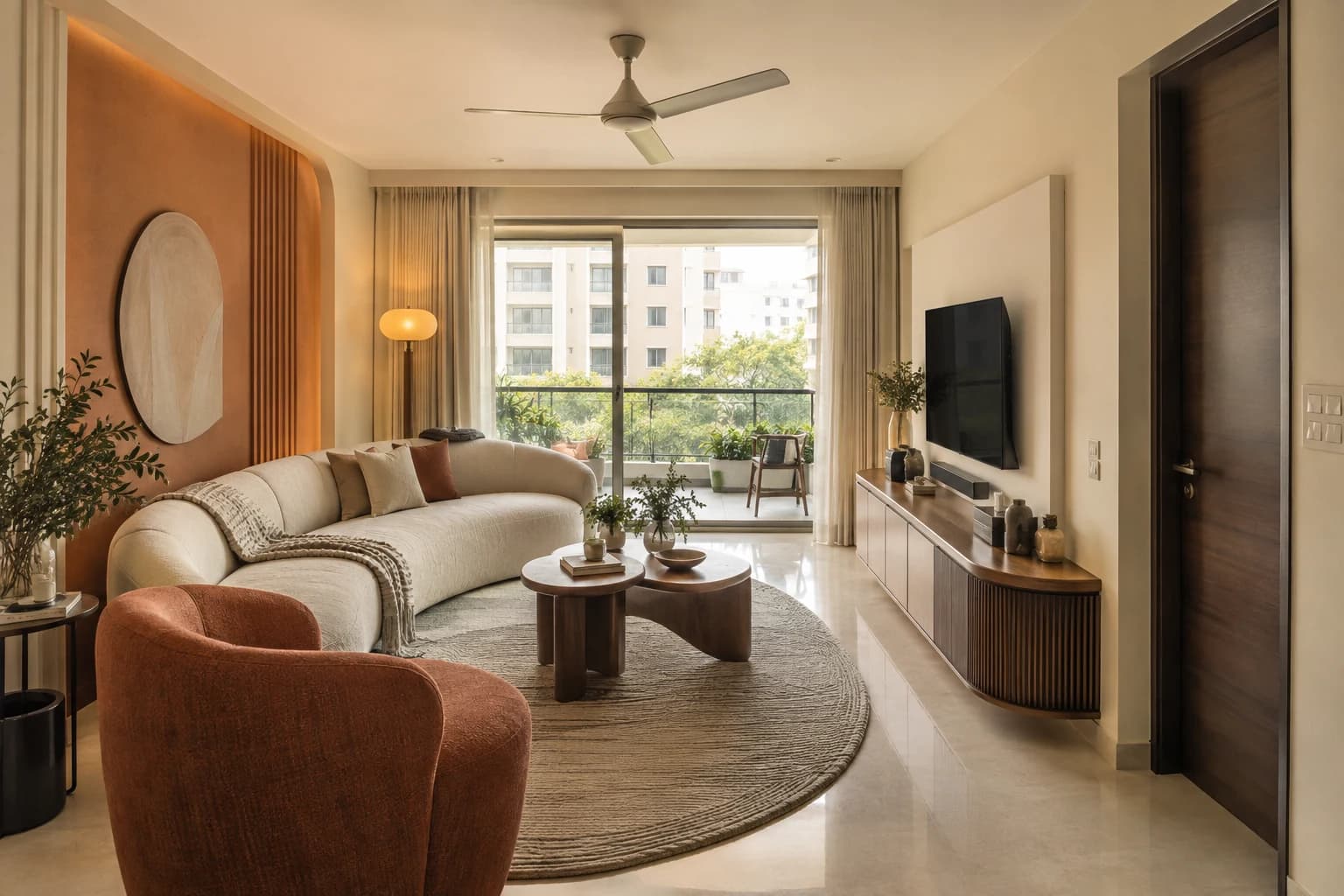
A curve should earn its place in the room, not just in the photograph.
Keep the kitchen working parts straightforward
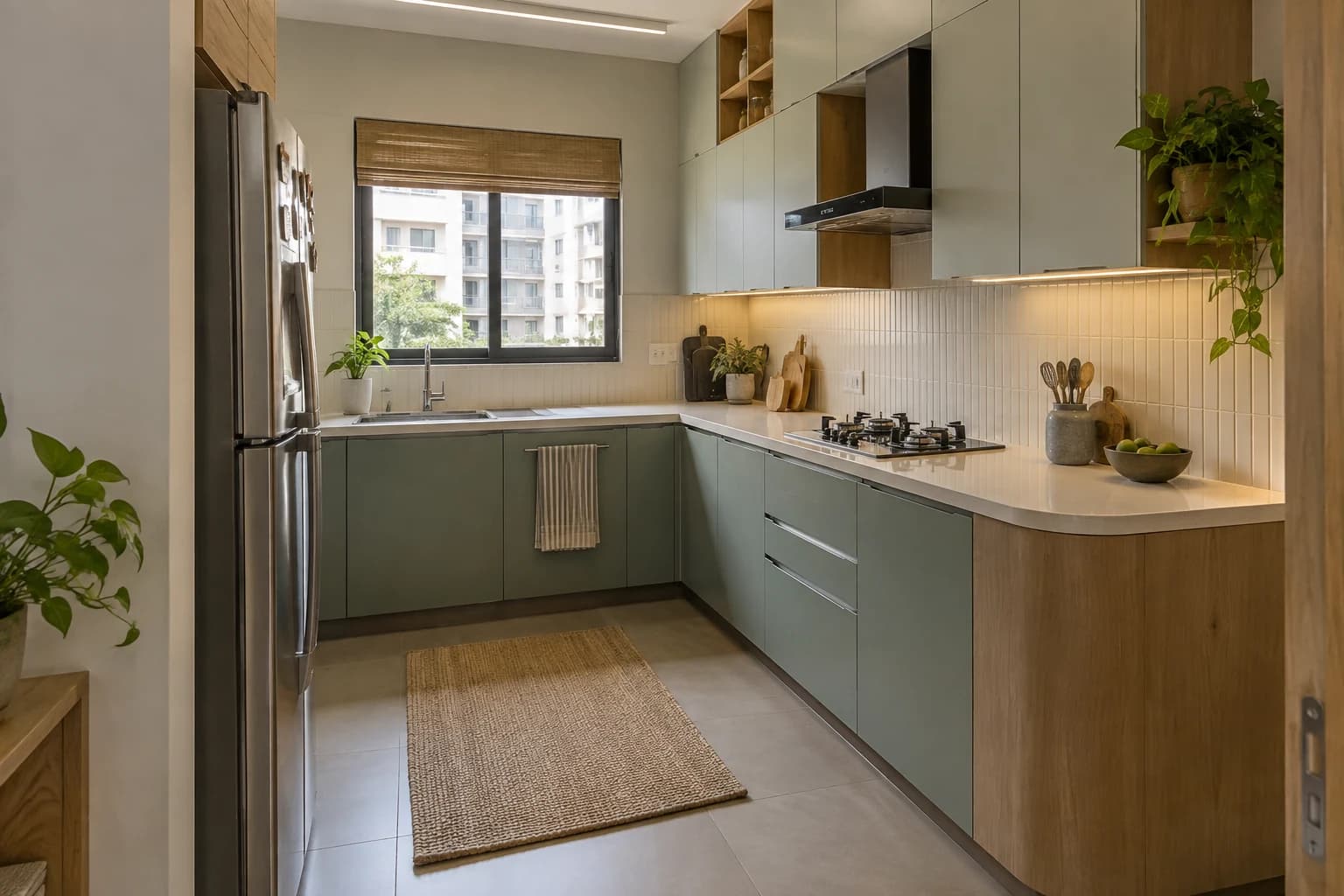
A rounded exposed cabinet end or the outside corner of a short breakfast peninsula can soften a kitchen without changing the entire plan. Keep the sink, hob, refrigerator and preparation area organised around how you cook. A curve should not take away the only useful stretch of worktop.
Most appliances and drawer systems are rectangular. It is often sensible to retain straight internal cabinets and introduce a curved external end treatment. Ask the joiner what storage remains usable, whether the curved end is decorative or functional, and how panels can be repaired or replaced.
Check the worktop fabrication, edge profile and support with the supplier. Rounded corners do not remove the need for appropriate clearances near heat, appliance ventilation or safe circulation. In a small parallel kitchen, a curved cabinet can consume precious aisle space; a modest radius on a straight run may be enough.
Dining curves are about people as much as shape
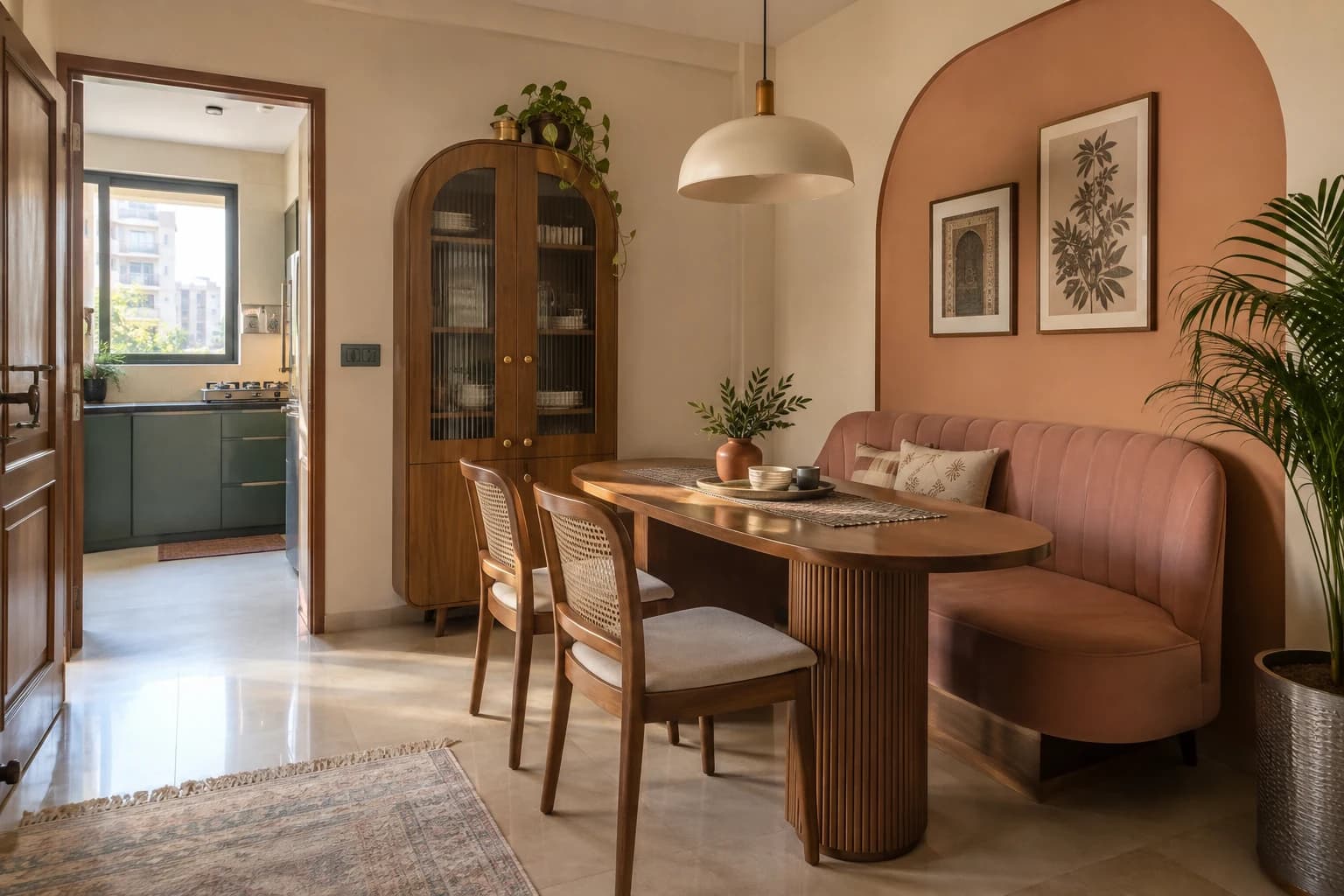
An oval table can be useful where people pass an exposed end, but it is not automatically the most space-efficient choice. Compare actual dimensions, leg positions and the number of comfortable seats. A central pedestal can free some knee space; a wide base can also get in the way of feet.
A curved banquette needs particular care. Test seat depth, the back angle and the relationship to the tabletop. A bench tucked neatly against a wall in a picture might be awkward for the person who needs to get out from the middle.
Let a rounded crockery cabinet or a small curved bench carry the idea if the table you already own works well. Repeating a wood tone or upholstery colour can connect old and new without replacing every piece.
Bedrooms: soften the outline, keep the useful space
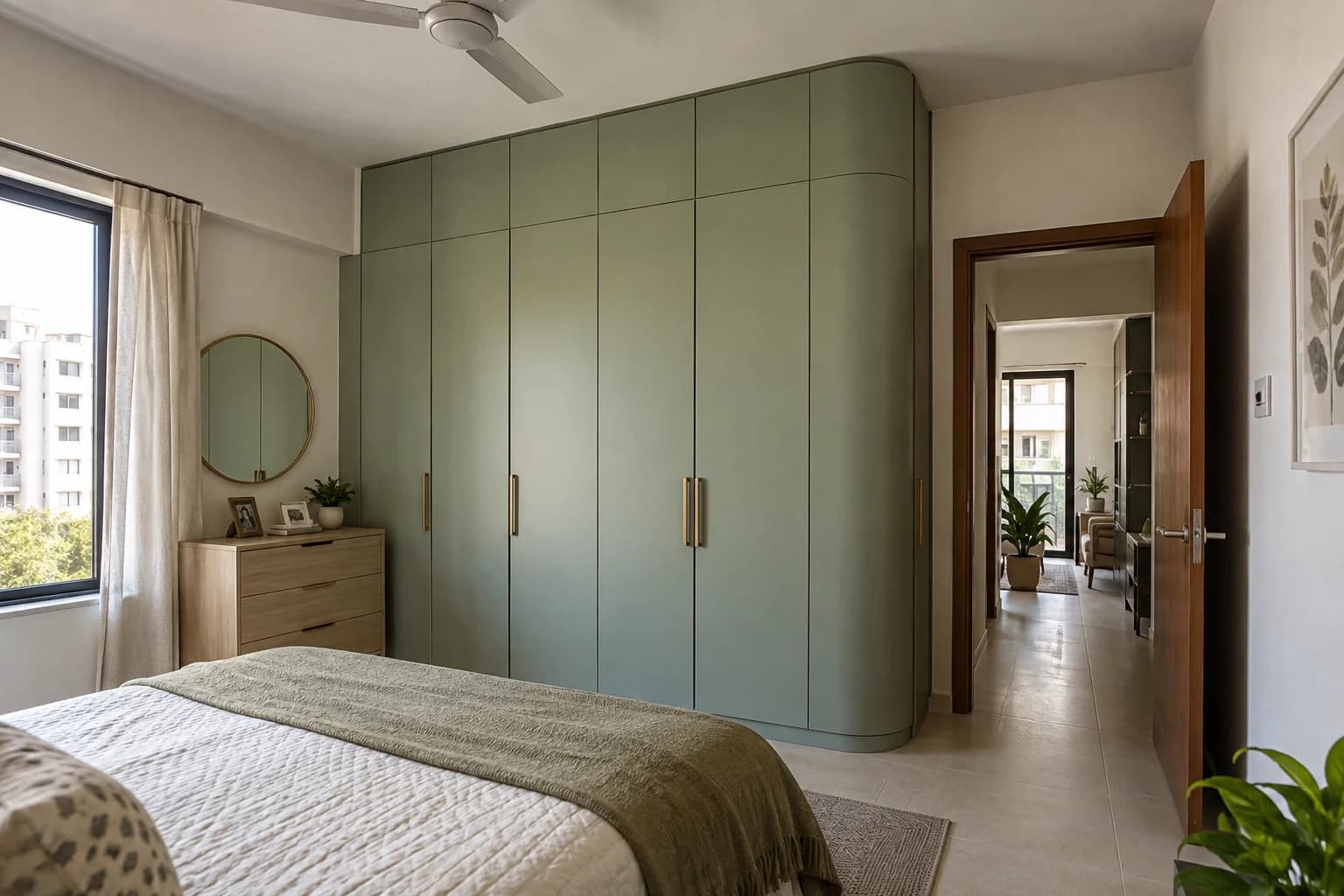
A broad upholstered headboard, softly rounded bedside drawers or a curved outer wardrobe corner can make a bedroom feel gentler. Keep the mattress size, access around the bed and wardrobe operation at the centre of the plan.
Curved bed frames can add several centimetres to the footprint around a conventional mattress. Check whether that extra upholstery leaves room for making the bed and opening drawers. An oversized decorative headboard can also compete with sockets, switches or bedside lighting.
For wardrobes, a radiused end panel is different from a curved opening door. Ask to see the hinge solution, door swing and usable internal depth. A full-height rounded silhouette should still have well-resolved panel junctions and accessible storage, not a collection of unusable pockets.
Small rooms and children’s rooms
In a small room, consider the surfaces you touch and pass rather than reshaping every wall. A rounded desk corner, a pill-shaped mirror or a simple painted arch can introduce the character without a major build. A painted shape is decoration; it does not create a real niche or extra space.
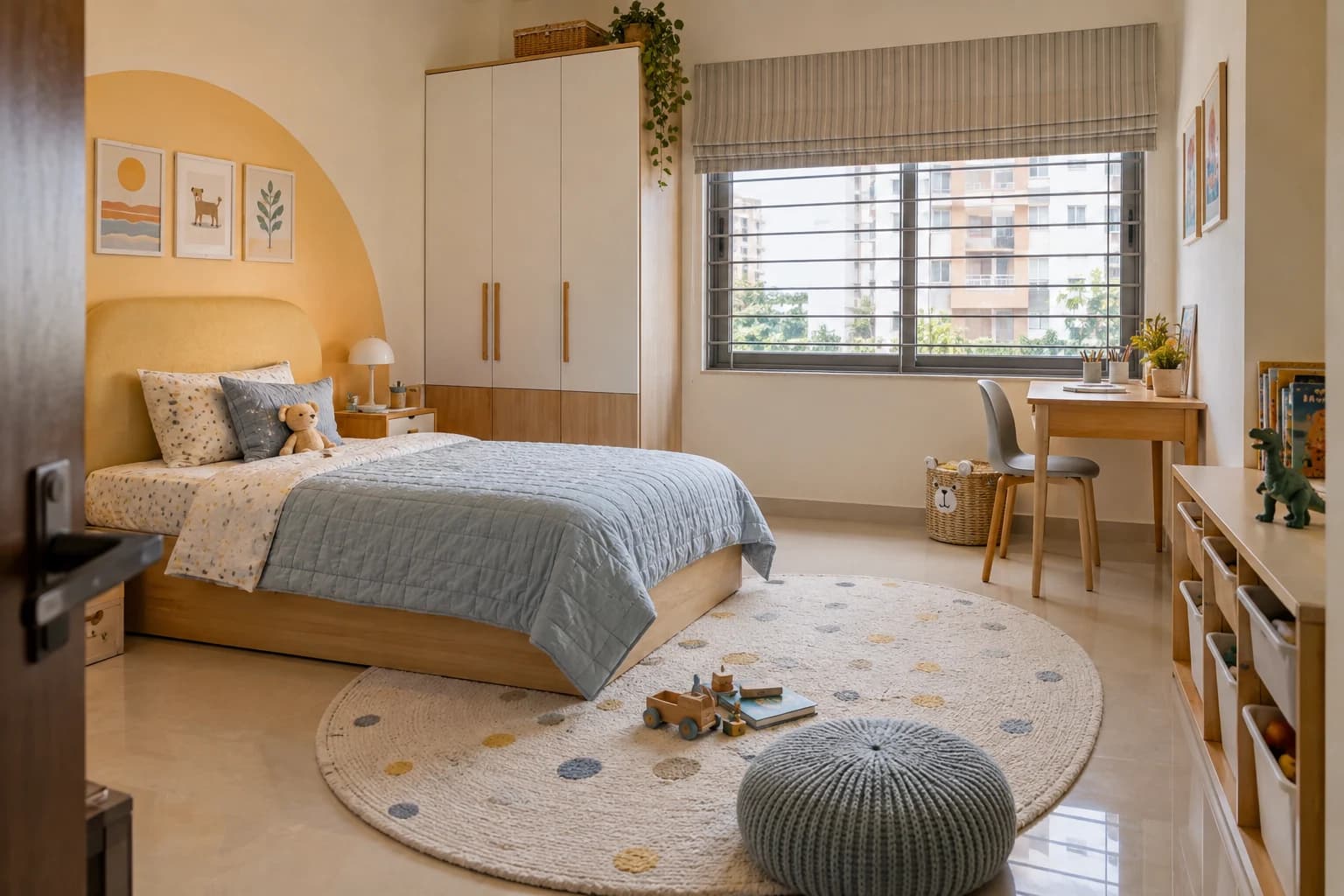
For children, a scalloped headboard and an oval rug can feel playful while remaining easy to update. Repeat a few colours and let toys, books and drawings provide the changing detail. Keep storage interiors straightforward and everyday items reachable.
Soft-looking edges do not make a room childproof. Stability, anti-tip anchoring, window safety, moving parts and appropriate material specifications need separate review. The practical kids’ room guide looks at these decisions in more detail.
Choose materials that can deliver the curve
Different radii and finishes call for different construction methods. Upholstery, formed plywood, suitable laminates, veneer and professionally designed decorative linings can all create different effects. Ask the maker which method suits the proposed curve rather than assuming any sheet material can bend to any shape.
Request a sample of the actual curved edge and finish. Check the seams, the change in grain direction and how the surface meets a straight panel. A small sample in your chosen colour can expose an awkward junction before it becomes a full wardrobe.
Think about cleaning and repair. A plain rounded surface may be easier to wipe than a deeply fluted one. Fabric wrapped around a complex silhouette may be harder to reupholster. Ask how an exposed corner will stand up to everyday knocks and whether a damaged part can be replaced.
For bathrooms and other wet areas, choose products, substrates and waterproofing details suitable for their use. A rounded vanity in an image tells you nothing about its resistance to water or how the basin and worktop have been sealed.
An arch is not permission to alter a wall
A painted arch, a surface-mounted decorative panel and a structural opening are entirely different projects. Establish which walls contain structure or services before any cutting or alteration. Obtain the necessary professional assessment and building or apartment approvals for the actual work.
Even non-structural curved linings can take away room width, hide access points or interfere with a door. Include their finished thickness on the plan. Keep maintenance access to services and ask how the lining will meet the ceiling, skirting and neighbouring cabinetry.
If the room is rented or the budget is limited, start with movable furniture, a mirror or a suitable paint treatment. You can explore the softer mood without committing to built-in architecture.
A complete curvy scheme, without the visual noise
Try this brief: warm neutral walls, one curved seat, a rounded wood surface and a single soft-edged joinery detail. Use a consistent family of curves rather than mixing tiny scallops, sharp arches and dramatic waves in every direction.
Then choose the contrast. A straight curtain track, a rectangular window or simple floor tiles can make curved objects feel more intentional. A home does not have to resemble a sculpted cave to be a fully considered soft-shape interior.
Bring two or three images to the design discussion and name the part you like in each. Is it the profile, the colour, the fabric or the sense of movement? That distinction helps turn an attractive reference into a buildable idea for your own flat.
Before you approve a curved detail
Check the full furniture footprint, clear routes, seated comfort and usable storage. Request a radius drawing and finish sample for bespoke work. Confirm fabrication, installation, access and repair responsibilities in the written specification.
Spend where the curve changes the experience: a comfortable seat, a better-resolved exposed corner or a headboard you love. Let simpler surrounding pieces support it. More custom geometry usually means more decisions to resolve, not automatically a better room.
The best curves feel natural to the way a room is used. If a softer shape makes the space beautiful but harder to live in, simplify it. A little generosity in the right place goes a long way.
Every home is different. These notes are a starting point for your own brief, with the details shaped around your space and the people who use it.
Thinking of someone who’d like this?
Send it to the people you’re planning with, or keep it on your reading list.